Spring framework.
Skilled in managing carrier-grade ISP infrastructure, enterprise environments, and server operations. Enthusiastic about optimizing high-performance networks and exploring emerging technologies. Committed to continuous learning and driven to leverage cloud solutions and automation tools to enhance innovation and efficiency.
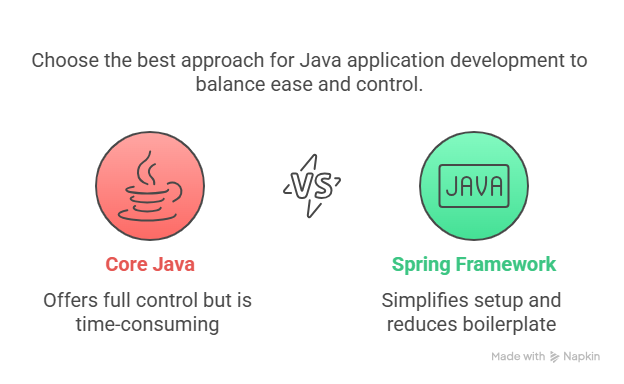
Building applications purely with core Java can be fun, but it’s often time-consuming. Tasks like connecting to a database or handling server-side rendering using plain servlets and JSP can get the job done, but the setup process alone can be quite exhausting.
That’s where frameworks like Spring come in. Spring acts as an abstraction layer that handles much of the boilerplate and setup for you, making it easier to focus on the core logic of your application instead of getting stuck in configuration.
Pre-requisites before learning spring framework would be understanding the basics of
(JDBC)
JDBC acts like a bridge between Java and databases. It helps your Java program:
Connect to a database (like MySQL, Oracle, PostgreSQL)
Send SQL queries
Get results from the database
Update or delete data
Imagine you’re building a Java app that needs to store user info. JDBC lets your app talk to the database, so you can save, retrieve, or modify that info.
(SERVLETS)
Servlets help you build dynamic websites using Java. When someone visits a webpage, a servlet can:
Receive the request (like form data)
Process it (e.g., check login info)
Send back a response (like showing a welcome message)
Key Points:
Run on a Java-enabled web server (like Apache Tomcat)
Use HTTP (like
doGet()anddoPost()methods)Generate HTML or other content dynamically
Think of servlets as the backend brain of a Java web app.
(JSP)
JSP lets you write HTML pages with Java code inside. It’s mainly used to display data (like user info or product lists) on a webpage.
Key Points:
Looks like HTML but can have Java code inside using
<% %>tagsEasier to write than servlets for web page content
Runs on a server and is turned into a servlet behind the scenes
Think of JSP as the presentation layer of a Java web app—perfect for designing pages that show dynamic content.
ORM Framework like (HIBERNATE)
Hibernate lets you store, update, delete, and fetch data from the database using Java objects instead of writing a lot of SQL code.
Key Points:
Maps Java classes to database tables
Handles relationships (like one-to-many) between objects
Makes database code cleaner and easier to manage
Automatically generates SQL behind the scenes
Think of Hibernate as a translator between Java and the database, so you can work in Java and let it handle the database part.
(Maven)
Maven helps you manage project dependencies, build your code, and organize your project structure easily.
Key Points:
Uses a
pom.xmlfile to define dependencies (libraries your project needs)Helps with compiling, testing, and packaging your code
Makes projects easy to share and maintain
Think of Maven as your Java project manager—it keeps everything organized and builds your project with one command.
I also struggled to grasp these concepts at first, but with the help of YouTube videos and AI tools, I was able to understand them better. Here’s a list of resources that really helped me.
https://www.youtube.com/watch?v=4XTsAAHW_Tc
In the next article, we’ll dive into the basics of Spring Core and gradually work our way toward building a full application using Spring Boot. Stay tuned!


